
Sizing & How-To
How to Measure Your Shoe Size at Home: Precision Fit & Sizing Guide
JUN. 15, 2026
Quick Answer: The At-Home Fitting Formula
While a professional Brannock Device assessment at a retail store is the gold standard, you can calculate your precise shoe size at home using simple household tools. To bypass the return cycle and avoid painful blisters, pinching, or rubbing, you must capture two critical biometrics: foot length (from heel to the longest toe) and foot width (across the ball of the foot). For absolute precision, always measure your feet in the late afternoon when they are fully expanded, stand upright to allow for natural weight-bearing elongation, and size your footwear to match your larger foot. For kids, check out our Printable Kids’ Size Chart to measure their fit quickly and easily at home.
The Biomechanics of a Weighted Footprint
When you buy shoes online, guessing your size is a recipe for foot fatigue and structural discomfort. The human foot is a dynamic, shifting structure; when you stand, your arch naturally flattens, causing the foot to expand and elongate under your body weight. If you measure your feet while sitting down, you risk buying shoes that are up to a half-size too small once you actually hit the pavement.
By gathering a few basic household items—two sheets of plain paper, a sharp pencil, a standard ruler or measuring tape, and a hard, flat surface (avoid carpets, which distort tracing lines)—you can reverse-engineer your perfect digital fit.
Method 1: The Paper Tracing System (Best for Families)
The paper tracing method is a tried-and-true diagnostic that maps the exact, two-dimensional footprint of both adults and rapidly growing children.
-
The Weighted Alignment: Place a sheet of paper flat on a hard floor. Wear the exact technical or casual socks you plan to pair with your new shoes. Stand completely upright, shifting your full body weight onto the tracking foot so it spreads to its natural size.
-
The Perpendicular Outline: Hold your pen or pencil completely vertical (90 degrees to the floor). Trace closely around your foot's outline. Ensure the writing utensil maintains continuous contact with the paper; tilting the pen inward or outward will completely warp your final calculation.
-
The Odometer Check: Repeat the entire process for your other foot. It is biologically common for one foot to be slightly larger than the other. Always highlight the measurements of the larger foot to dictate your final size selection.
-
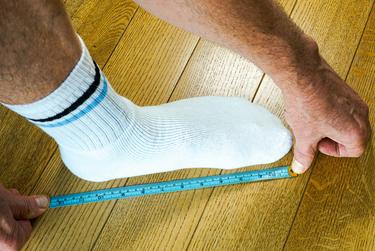
The Length & Width Extraction: Use your ruler to measure the straight line from the absolute back of your heel to the tip of your longest toe (keep in mind, this is often the second toe rather than the big toe). Next, measure the distance across the widest part of the ball of your foot to calculate your true width category.
Method 2: The Wall Baseline Test (Best for Speed and Accuracy)
If you struggle to keep your pencil perfectly vertical while tracing, the wall method provides an immovable structural baseline to eliminate human error.
-
Set the Target: Position a measuring tape or ruler flat on a hard floor, anchoring the zero-inch mark flush against a flat wall.
-
Anchor the Heel: Step onto the measuring device, pressing the absolute back of your heel firmly against the wall. Stand straight, distributing your weight evenly across both limbs.
-
Isolate the True Length: Look straight down and record the exact measurement directly aligned with the tip of your longest toe.
-
Map the Ball of the Foot: Keep your foot flat and slide your ruler horizontally across the ball of your foot to register the widest point.
Pro Tips to Outsmart Brand-Sizing Variations
-
Account for Your Arch Architecture: If you possess rigid high arches or structurally flat feet, your foot behaves differently under load. High arches require extra vertical volume in the upper, while flat feet often need a wider base platform to prevent the foot from spilling over the side of the midsole.
-
The Sizing Insert Fix: If your at-home measurements reveal a significant size discrepancy between your left and right foot, always buy the shoe size that fits the larger foot. You can easily balance the fit of the smaller foot by using a supportive aftermarket insole or a targeted heel insert.
-
The Children's Cushion Rule: Because kids' feet undergo rapid growth spurts, use a printable shoe size chart and intentionally select a size that leaves a little room for growth (roughly a thumb's width). Ensure the shoe offers a flexible sole to foster natural stride development.
?fmt=auto&w=150)
